The Farmer's Journey

Status
Not open for further replies.

[ATA]Grant

Administrator
A Thinking Ape


On a hillside in the foothills leading to a low and arid mountain range, two figures stood amid the brush in the light of the evening sun.

One of the figures, scanned the dry and sparsely wooded plains stretching out below them, turning to desert as they reached the horizon. After a few moments, The Mage pointed into the distance at a seemingly unremarkable acre of tall grasses.

“There,” he muttered to his companion, a young woman dressed in acolyte’s robes, “north of the path, where the heather grows thick. There is a lone oak tree. It marks the south-east corner of the homestead.”

The acolyte stared down onto the heath, eyes shining with reverence. “The Hallowed Farmer’s birthplace,” she whispered, “the actual birthplace…”

She had spent many years studying the sacred texts documenting the life of the Farmer. The Mage regularly underwent the pilgrimage retracing the Farmer’s journey, and had allowed her to accompany him as part of her induction into the Order. This was their first stop.

“Yes,” said the Mage. “where He was born and so much more. It was there He underwent His first trial, the first of many. It was there He was first betrayed, and there He reaped His first vengeance.”

The acolyte, nearly overcome by the weight of history, clasped a small medallion hanging from a chain around her neck. It bore the symbol of a golden sickle. In her other hand was a book from the scriptures, the First Book of Holy Canon.

The Mage turned to the acolyte. “Let us begin the ceremony of remembrance,” he said.

He then raised his hand into the air and began to intone words of power. A dazzling light began to shine from it, and around their feet green shoots sprang up into stalks of golden wheat before the acolyte’s eyes.

After a few moments, the Mage fell silent again and the light faded. The sense of wild growth, however, remained in the air.


The acolyte opened her book, and began to read aloud...

**********

(2 Tes. 5:12-25 First Canon)
And so did the Boy run through the dark of the night, His father’s urgent words echoing in His ears:

“Run! You must warn the baron! The bandits of the mountains are nearly here! Run and do not look back!”

In His left hand He held His trusted sickle. In His right, a small pouch containing the remainder of His family’s meagre coin. His father had pressed it into His hand as he sent Him for help.

And so did the Boy run with all speed from the farmhouse, in the weak light of a crescent moon. Over famished lands and fields, untended by man or nature. So He ran on, heedless to all, to the lodge of the baron.

The light of many torches met Him first as He neared the baron’s stately dwelling. Second was the sound of many voices raised in revelry, as if in celebration of a victory. No further greeting would He receive.

And so the Boy ran unnoticed into the bright lodge and into the great hall in which the baron, his knights, and his guests of high birth were feasting.

And the Boy ran past the entourage and threw Himself on the floor of the hall before the baron’s splendid oaken throne, and the gathering at once fell silent, and all that could be heard were the Boy’s frenzied pleas for help.

He warned that the bandits of the mountains had gathered in the foothills and had begun raiding the farmsteads in the fields belonging to the baron. He begged the baron to send aid and save his family. And the Boy finished His plea, but no one else spoke in the hall for some time.

And after a time, the baron stood up from his seat and approached the Boy. He picked up the pouch of coins the Boy had brought, and after weighing it in his hand, he declared to the rest of the room that it wasn’t enough to pay off the taxes owed to him by his brother. His words pleased the gathered company greatly, and a roar of mocking laughter rose from the party.

And the baron then took a great steel sword, nearly as tall and as heavy as the Boy Himself, from one of his knights, and flung the giant blade at the Boy’s feet, and told Him to accept it as a gift from His uncle, and that he could go rescue His family Himself. This further amused the company, and their laughter grew more raucous and mocking.

But an uncanny light of anger had entered the Boy’s eyes. He took up the heavy sword in His right hand and threw it in one motion, as if it weighed no more than a grain of wheat, at the oaken throne, which was split in two by the blow.

And the baron, stunned at what he witnessed, fell silent once again with the rest of those in the great hall, as the Boy hurled Himself from the room in demonic haste.

And so did the Boy run frenziedly back over blighted pastures, whose scant offerings of seedlings were crushed under His pounding feet. In His left hand He still held His keen sickle, but His right hand was empty.

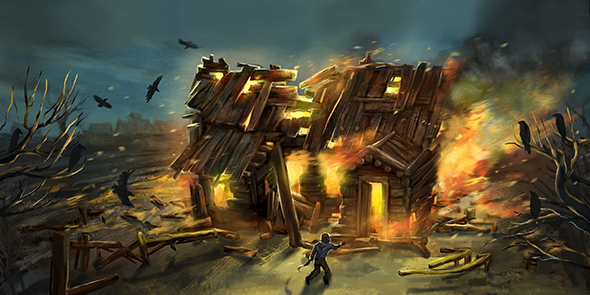
And so was the Boy greeted once again by firelight as He neared His home, but this time it was not the light of the torch, but the light of His home, ablaze. And as He fell to His knees before the fire, He was also greeted once again by the sound of cruel laughter.

And there by the burning homestead was a band of brigands, two dozen strong, who had come down out of the mountains to raid at their pleasure, for the baron had long since withdrawn his protection, and the bandits knew this.

And the leader of the bandits grinned with amusement as the Boy stood up and approached him, for he did not recognize the light of death in the Boy’s eyes, and the rest of the band laughed at the Boy’s impudence.

And when the Boy asked if they had killed the family that lived in the house, the leader of the bandits, to the great delight of his men, answered with one word only:

“Eventually.”

**********

(2 Tes. 5:28-30 First Canon)
And so the sun rose at last upon the Boy, who sat among the scant brown grasses of what was once His family’s wheat field, where he had buried the remains of His father, His mother, and His sister.

And the rays of the sun fell upon the ashen remnants of His home, which had burned through the night, having been fed the corpses of the bandit invaders.

And the rays of the sun shone upon His gleaming sickle, which He had now cleansed of blood and polished to a mirror sheen after a full night’s harvesting.

And the rays fell upon the Boy, whose lust for vengeance had at last subsided enough for Him to lay His family to rest. The burning wrath in His eyes was now a cold resolve.

And with His sickle in His left hand, and a sack of bandit’s heads slung over His right shoulder, the Boy set off to see the king.

**********

Her recitation finished, the acolyte closed the book. The two had wandered back to their horses at the bottom of the hill.

“So concludes the ceremony,” said the Mage. “The hour grows late, let us be on our way.”

The acolyte took one last look at the Holy site, then the two mounted their steeds and began to walk east out of the valley.

“I have often wondered,” said the acolyte as they rode, “about the chapter’s ending. What was the significance of the sack of bandit’s heads He carried?”

“Yes, the sack of bandit’s heads, known in some translations as the ‘bag of skulls.’ It is said that He intended to lay them out before the king as proof of the baron’s treachery and abandonment of his serfs. Some historians even say that the eyepatches worn by the bandits bore a sigil signifying they were secretly in the baron’s employ. Others simply point to it as proof of the Farmer’s incredible strength and martial prowess even from a young age.

“In any case, you will recall that by the time the Farmer begins His time in the desert, He is no longer in possession of it, having buried them at the behest of the Aradmeli Rab…”

They continued, now in conversation, now in thought, as they made their way to the next stage of the pilgrimage, toward distant deserts coronated by the setting sun.


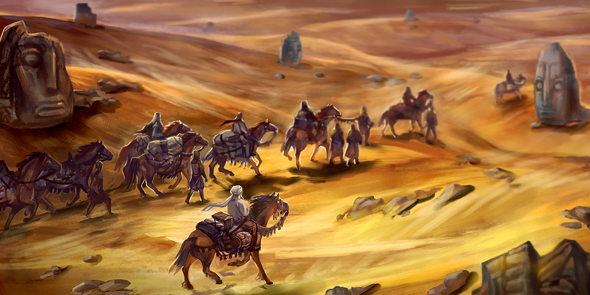
The acolyte sat on a stone outcrop in the middle of the desert in the gathering dusk. The sun had nearly sunk behind the dunes and a crescent moon was beginning to reveal itself as the obscuring glare of day began to soften.

She had been following the road through the desert with the Mage for two full days now, and by this time all that was visible from horizon to horizon was sand. From what he had told her, it would be at least two more nights before the road would bring them out of the desert to the next leg of their pilgrimage.

Although they were adequately provisioned for the desert crossing, the acolyte ate and drank as sparingly as she could, in case they needed their supplies to last. Moreover, she had wanted a glimpse into tribulations experienced by the Farmer during his years crisscrossing the desert with the Aradmel tribe.

However, she was unused to such deprivations, and her thirst had already carved lines into her dry lips. She knew their horses would be comfortable and well-fed, the Mage’s magic saw to that. As for the Mage himself, she had yet to see him eat or drink.

Next to the acolyte, the small twig fire she had built was softly crackling. The mounts were tied to a tenacious zaera bush that was clinging on to the edge of the outcrop.

In the near distance was the desert road, where the Mage was in conversation with a mounted man in fawn-colored robes, out of earshot of the acolyte, who was looking on with curiosity. After a time, the rider loosened a large cloth-covered package that had been fastened to his horse behind him and handed it to the Mage, who in turn handed the man a handful of gold.

After this transaction, the rider nodded to the Mage and rode away at a canter. The Mage then returned to their encampment with his new parcel.

He sat down opposite the Acolyte in front of the little fire and carefully placed the mysterious package down onto the stone floor next to him without a word.

The acolyte, who had completely forgotten her hunger and thirst in her curiosity, was about to ask about the Mage’s purchase, when suddenly he spoke:

“Do you recall,” he said, “our conversation from this morning regarding the Book of Aradmel?”

“Y-yes…” replied the acolyte, caught off-balance by the sudden questioning.

“You mentioned that you were frustrated by the lack of writings chronicling the Farmer’s years in the desert,” said the Mage, turning to the cloth-bound package and reaching a hand inside.

“Yes, and you mentioned that new scrolls from that era had been found and were being transcribed by…” she cut herself off with a shocked gasp that startled the horses as the Mage drew a new-looking scroll out of the package. “Is THAT…?” she asked breathlessly.

“Mm,” replied the Mage. “My merchant friend back there brought me one of the first copies of the new readings. The translation is still a bit spotty in places, and much has been left out while scholars verify the authenticity of the statements, but I believe you will learn much.”

He handed the scroll around the fire to the acolyte, who was trembling with excitement. “The scrolls are mainly the writings of an unnamed Aradmeli chronicler during the time of the Farmer. Perhaps you could read some of it to me now…”


9 First Moon, 3833

This morning marked the passing of Sapra’Arpoa, 42nd chronicler to the Aradmel. May the Celestials guide his soul.

It is with a mournful heart that I, Deyn’Aetkat, assume his duty as 43rd scribe and chronicler of the tribe of the Aradmel, greatest of the three tribes cursed to forever wander the Dabroa (Translator’s Note: refers to the desert, but can also refer to the name of the territory, lit. “great sand”).

All praise to our leader, the most wise Dhakiym, fountain of the dunes, warden of the star chart, 28th rab (T/N: chief, lit.“shepherd”) of the Aradmeli people.

12 First Moon, 3833

The duties of a chronicler are simple. I observe and record any extraordinary events, that future generations may learn from them. Since very little changes for us, there is not much to record.

We do what we must to survive in this harsh land, criss-crossing the Dabroa, endlessly traveling from one b’ganteh (T/N: these were areas where small growths of zaera flowers were known to be, lit. “blossom garden”) to another.

Our lives are strictly governed by our precious star charts and the blooming schedule of the zaera. Sometimes, we will encounter one of the other tribes, and blood will be shed, but always we must keep moving. To tarry for too long is death.

13 First Moon, 3833

Already, a curious event to record! Today, a few hours before encampment, the elder L’fiq spotted a prone figure among the dunes. It turned out to be a young man, unconscious but still alive!

According to our laws, we are forbidden to give aid to outsiders, but the kindly old L’fiq petitioned the rab to make an exception. Our wise and generous rab agreed, and immediately called for the healers.

A tent was put up, and the healers carried in the boy. They gave him water and applied balms to his grievous sunburns.

Even more curious, however, was that the boy was clutching a large sack, which he would not release even though he was unconscious. I do not know what was in that sack, but it stank, and was surrounded by biting flies. I shudder to think what it might contain...

14 First Moon, 3833

A few hours after moonrise, the young man awoke! The healers tried to question the boy, but he did not understand our tongue. Indeed, when I looked upon him again I saw that his clothing was not of any of the Dabroan tribes.

The healers rejoiced to see the boy awaken, but the rab seemed to be concerned about something. And then I realized what was troubling him so.

Our tribe’s laws forbid the giving of aid to any outsiders, due to the scarceness of our resources. By saving the boy’s life therefore, he was inducting him into the Aradmel.

As a member of the tribe, he is now cursed as we are never to leave the Dabroa. By rescuing the boy, he has condemned him to share in our fate.

Then there is the other question that bites at the back of our minds like the flies surrounding the mysterious sack:

What in the world could have driven this young man from the green nations all the way into the middle of the Dabroa all alone?

19 First Moon, 3833

We have arrived at Rakshoa B’ganteh (T/N: the various b’ganteh were named after the constellations on the tribal star charts used to locate them, in this case “horse garden”) on schedule, despite delays.

The mysterious young man is adjusting quite well to Aradmeli daily life. Our rab has adopted him, and has taken to calling him D’alyan (T/N: affectionate term for a son or a young male relative, lit. “boy”).

He has been showing D’alyan our ways, how to gather food, how to navigate by the stars, how to wield a scimitar on horseback and so on. The elder L’fiq has been teaching him the proper use of a magalteh (T/N: a small sickle-like gardening tool) to collect precious zaera to feed our mayoa m’abea (T/N: magical urns used by desert tribes to create water, lit. “water fountain”).

D’alyan is not only gifted in the use of the magalteh, he is an exceedingly hard worker, and is always the last to lay down his burden. L’fiq believes he might have been one of the lak’roa (T/N: farmers, lit. “grain-men”) from the outside countries.

And what of the mysterious sack of horror the boy held on to so tenaciously?

The morning after D’alyan awoke for the first time, the rab went to see him.

“My son,” he said to him, “I don’t know what has driven you here, but I know d’atreg’ah (T/N: a force or madness that drives a person to extreme lengths for revenge, lit. “vengeance-lust”) when I see it.”

He carefully placed a hand around the neck of the sack.

“Let us bury your burden, before the flies pick your bones clean. I will show you how to get your revenge. I swear it!”

The rab then took a magalteh from his belt and made a stabbing motion in the air with it. He then opened D’alyan’s free hand and placed the magalteh in it.

D’alyan said nothing, but he seemed to understand, and he allowed the sack to be taken away. We buried it as deeply as we could, and moved on.

*********************

“But how could he make such a vow,” asked the acolyte, lowering the scroll, “if they are cursed never to be able to leave the desert?”

“An interesting conundrum,” replied the Mage. “let us move forward a few years.”

*********************

21 Third Moon, 3835

D’alyan has returned from his scouting mission to the Serpent B’ganteh. He reports that the zaera and besmoa blossoms are abundant, and there is no sign of the Mayadh tribe.

All are pleased at D’alyan’s return, for he is well-liked among all in the tribe. None are more pleased than our great rab Dhakiym and his family, however, particularly his third daughter B’Lil’Zaera, who among the rab’s daughters seems to show him the most affection.

There has been talk that that the rab may choose D’alyan as his successor, for he has mastered our language and our ways, and has shown himself to be both a fearless warrior and a skillful harvester.

Thanks to his skills as a lak’roa, he has even managed to coax more growth out of each b’ganteh we visit. Over the past few years, they have grown comparatively lush with zaera. Not only has this made our lives easier, it has almost completely eliminated the need to battle with the other tribes, and skirmishes have become rare.

Some even gossip that D’alyan may be the one spoken of in the prophecy, who will bring us victory against our brother tribes and someday lead us out of the Dabroa.

Our rab will not reveal his own thoughts on the matter. However, today he declared that “D’alyan” is not a name worthy for a man, and has given him the name Tabat’Sheb.

*********************

“Tabat’Sheb, ‘the blade of vengeance,’” said the acolyte.

“Correct. They still use that name when writing about The Farmer in the desert nations, I am led to understand. It shows that Dhakiym had not forgotten his promise to Him. Apt.” said the Mage, “You recall, by the way, the prophecy of the Aradmeli seers?”

“It said...that only one tribe may leave the desert, and that he who leads that tribe will break the curse at the cost of his life, or a fate worse than death, depending on the translation,” recalled the acolyte.

The Mage nodded, staring into the now-starlit horizon.

“I think,” he said after a few moments, “that I should like you to jump to the end.”

The acolyte rolled through the scroll until she reached a point a few entries from the end.

*********************

14 Tenth Moon, 3855

Today was the day of the summit of the three rabs of the Dabroa. All three tribes gathered at Rakshoa B’ganteh last night for the meeting at one hour after dawn.

A large tent was erected near the b’ganteh, at the center of which sat the three leaders: Khalyt the Strong, rab of the Mayadh, Meiynoa the Stalwart, rab of the Abayadh, and our own rab, the peerless Tabat’Sheb.

Around the periphery of the inside of the tent stood their bodyguards, advisors, and chroniclers. Outside, the three tribes mingled anxiously, but peacefully. (T/N: there is a separate scroll with the full transcript of the meeting, however it not yet fully translated).

At the arrival of the hour, our rab bade the others welcome to his tent, and explained the reason for the summit; he believed that the time had come for the tribes to fulfill the prophecy and leave the desert.

This pronouncement was met with scorn by Khalyt, who accused our rab of setting a trap! But Meiynoa said her sages and seers had advised her that a great change was to come to the tribes of the desert.

Khalyt angrily pointed out that, despite the new abundance of zaera, they had gambled nearly all their water and resources by breaking their schedule of travel to attend the summit, and even threatened to attack the Aradmel to take their resources if it didn’t prove to be worth the while of the Mayadhi people. Again, Meiynoa bade him listen to the words of our rab.

The great Tabat’Sheb then revealed his plan. One of his sons would go to Mayadh to marry one of the daughters of Khalyt, and one of his daughters would be wed to the son of Meiynoa and join the Abayadh.

In this way, all three tribes would unite, and would finally be able to leave the Dabroa for the green lands.

The plan was met with more derision by Khalyt. He countered that past rabs had considered the idea, but the risk was far too great. If the plan failed, there would not be enough zaera at the nearest b’ganteh for all, and many would die of thirst before the next one could be reached.

However, Meiynoa declared that she saw the wisdom of our rab’s words, and the three leaders continued to argue their positions. The three leaders argued in this fashion for several hours, but in the end they declared that the weddings would take place immediately, and the three tribes would travel as one to Yalmeya at dawn.

15 Tenth Moon, 3855

At dawn today, the newly united tribe of the Aradmel led by Tabat’Sheb, rab of rabs, departed Rakshoa B’ganteh for Yalmeya Pass, the place where it is prophesied that the curse of the Dabroan tribes will be broken.

We members of the old Aradmel tribe ride with heavy heart, for all know that our beloved rab rides to his doom. The rab’s wife B’Lil’Zaera weeps bitterly as she rides, and Meiynoa and even Khalyt’s faces are solemn.

It is early afternoon, and as I write this we are approaching Yalmeya. It is a forbidding wall of high brown cliffs that blocks the sands in every direction as far as the eye can see. The only way through is Yalmeya Pass, a canyon between the rock walls that leads to the green countries.

(later)

As I write this, my heart is filled with pride! The rab has stopped the caravan about a quarter of a mile from the pass. He has declared that he himself will go first, accompanied only by his advisor L’fiq and myself!

After a brief consultation with Khalyt and Meiynoa, we set off.

After about fifteen minutes, we are close to the pass, and my heart nearly stops. There is a man standing on the eastern cliffside! I can see the man is wearing a suit of filigreed silver armor that shines as brightly as the sun, but I cannot see his face.

The rab hails him, and the man calls back thus:

“Mighty Tabat’Sheb, cultivator of the B’ganteh, warden of the star chart, 29th rab of the tribe of the Aradmel! You have come to the appointed place as per the ancient covenant!” Although he has an accent I do not recognize, he speaks in the Aradmeli tongue!

I am cold with fear now, fear for my rab. My rab, however, shows no fear as he replies to the affirmative.

“I await you in the canyon, O rab.” calls the man in shining silver.

The rab and L’fiq dismount and walk their horses into the valley. I will follow.

17 Tenth Moon, 3855

This is my final entry as scribe of the Aradmel. I will now report what occurred after we entered the pass.

We walked through the entrance to the canyon and on for a few minutes. My rab’s face showed nothing but determination. On L’fiq’s face was nothing but sadness.

After about a quarter of an hour, we turned a corner and came upon a sudden widening of the valley, far wider than the narrow corridor along which we had been traveling. Inside this open area, scores and scores of soldiers, some mounted, some on foot, were waiting. All were encased in metal armor and armed with shining weapons.

I felt as if the ground beneath my feet had dropped away, yet my rab’s expression was unchanged. Perhaps he felt this was part of the fulfilling of the prophecy.

A thousand longbows were trained on us, as I heard, as if from far away, the voice of L’fiq say “Take their horses and their weapons and clap them in chains.”

The rab and I were chained hand and foot and carried by soldiers up a path in the cliffside, accompanied by the traitor L’fiq, to where the man in shining silver armor waited.

At the top of the cliff, we were thrown face-first to the ground before the man. I heard him ask someone:

“This is the one, is it? This man?”

To which I heard the voice of L’fiq reply:

“He is certainly the one, my liege.”

At this, the man took a handful of my hair and wrenched my head up off the ground, and I could see from the corner of my eye that he did the same to the rab. He directed our faces out towards the Dabroa, where I could just make out our tribe, still waiting for our signal to proceed.

Next to me, I heard the man in silver say to my rab:

“I hear you had a gift for us, yet you arrive empty-handed? Filth.”

I did not understand what he meant. Then he said:

“Attack.”

Behind us, I heard the old man call out some sort of signal, then watched in horror as hundreds upon hundreds of armored soldiers poured out of Yalmeya Pass. All the while, the man held our heads up, that we would be forced to watch the ensuing slaughter.

Our tribe could certainly see the soldiers charging towards them, but were still caught by surprise. We had no enemies outside of the desert! We were never prepared for such a deceitful onslaught.

I shut my eyes and wept. All I could hear were my rab’s screams of rage.

After a time that I could not measure, the rab was taken away. I do not know where they took him.

I expected to be thrown from the cliff, yet I heard L’fiq say:

“Take the girl back to the pass and unchain her. Make sure she lives, that she may record all she has seen.”

And so I was forced to survive. I yet hold out hope of finding other survivors in the Dabroa, but I will not be able to survive for much longer myself.

I pray to all the Celestials for our dear rab. May he live to achieve the vengeance our old rab once promised him.

*********************

“That is the end of the scroll,” said the acolyte, stunned, her mind racing with questions. The Mage sat in silence, eyes shut in contemplation.

“A most interesting insight,” the Mage said at last, as the acolyte rolled the scroll back up. The sun had long since set and the stars shone brightly in the cloudless desert sky.

“So this is how He was betrayed, by this elder, L’fiq. And the man in the armor must have been the king from the legends, who held the Hallowed One prisoner! But what could possibly have made him do such a thing?”

“I believe that he was never a part of the tribe, but was from the start in the employ of the king,” replied the Mage. “He had, perhaps, been found wandering the desert, much as the Farmer had been, and integrated himself into the Aradmel at the behest of his king in order to help the tribe find the Farmer in the desert. They had their own prophecies to fulfill, you see.”

“Is this also why he spared the life of the archivist?” said the acolyte.

“Mm, indeed, and this is the clearest account there has ever been of the capture,” answered the Mage. “The fact that these scrolls exist at all is a virtual miracle, considering how difficult it was for these desert tribes to procure the necessary materials. Devilishly difficult to translate, considering how tiny the original writing was. And they would never have existed at all, were it not for the inexplicable mercy of this ‘L’fiq.’

“And now, we have a much greater insight into the Holy Farmer’s formative years in the desert, and a meaningful addendum for the Book of Aradmel. We also have a firsthand account of His first meeting with His nemesis.”

The acolyte, having rolled up the scroll, placed it into her pack. Her eyes were still wide and her heart was beating quickly. “Such a cruel life,” she said, “rushing from garden to garden, gathering flowers to squeeze what moisture they could from them, a whole tribe surviving on droplets.”

“Oh no, not quite! Oh!” exclaimed the Mage suddenly, “I nearly forgot…”

He turned back into the large clothbound package out of which he had pulled the scroll and unwrapped it.

The acolyte gasped in astonishment for the second time that night. “A Mayoa Fountain!! An authentic one?”

The Mage walked over to the edge of the outcrop and set the urn’s pointed base into the sand, where it stood upright. He then reached into it and pulled out a small bag, which he emptied onto the sand. Four slightly dried but colorful flower blossoms tumbled out. The acolyte leapt up and ran over to the Mayoa Fountain like a delighted child.

“Let us find out,” said the Mage solemnly. He placed the flowers into the urn and intoned a few words in an ancient language.

There was a brief glow from the stone on the front of the jar.

A few seconds later, clear water began to bubble merrily out of the Mayoa Fountain, splashing down onto the sand.


The main road leading to the holy city of Ciro, birthplace of St. Timaios, was like a slow-flowing river fed by streams from all four corners of the kingdoms.

A great mass of traders, buskers, and most of all, pilgrims, moved steadily up the road to the city towards its main feature, the Grand Temple of St. Timaios. Musicians sang as they walked, while roadside merchants peddled trinkets at passersby. Although it was customary to fast while on the pilgrimage, food vendors swam up and down through the crowd doing their best to entice the hungry faithful to cheat.

Walking their horses amid the great press of life were the Mage and the Acolyte. Although the journey from the desert to the holy city would only have taken a few days on horseback on an empty road, the slow progress of the crowds meant that it was the seventh day since they left the edge of the desert, and by the Mage’s estimation they were still two or three days away from their destination.

The sky was thickly overcast for two days now, though no rain had fallen and there was only the occasional rumble of distant thunder. A refreshing breeze wove its way through the masses, and the solemnity of pilgrimage had given way to the pleasure of travel and of being out of doors in fine weather.

Despite the crawling pace and the constant noise, the acolyte was enjoying herself a great deal, albeit guiltily. She chided herself for not using her time on the road to Ciro for prayer and study. However, the vigor of the surrounding river of humanity was a rare change from the silence of the abbey and a heady contrast to the desolation of the desert, and she could not suppress a spark of excitement and curiosity in her heart.

For the most part, the acolyte and the Mage did not attempt to speak to each other over the noise of the crowd. The acolyte occasionally tried to read one or another of her texts, but always found herself watching the other travelers instead.

The Mage did not look around at all, but stared straight ahead with his customary frown of concentration, purposefully perusing his mental libraries.

After a noon meal of bread from a roadside vendor, the acolyte noticed that the noise of the crowd had diminished enough to allow conversation. She turned to the Mage and remarked:

“I see many here who are either quite young or very old.”

“Yes, it’s the wars,” replied the Mage. “Most men or women of fighting age have been enlisted. Those waiting for their return pray for their glory in battle. Many undertake the journey to Ciro in the hopes that St. Timaios will deliver their prayers for victory to the Great Farmer.”

The acolyte nodded, and clasping the symbol hanging from her necklace whispered a battle prayer before continuing, “St. Timaios was a nobleman before he met The Farmer, was he not?”

“Yes, he came from quite a prestigious family, apparently. I say ‘apparently’ because most records of the family were altered or destroyed after he was imprisoned,” said the Mage.

“‘The Great Leveler of wheat and men.’ Chronicles, 26.4,” quoted the Acolyte. “In life and in death, all are equal before Him.”

“Death and the dungeon make equals of us all,” replied the Mage. “St. Timaios was not a particularly virtuous or brave man, but he was well-educated and and keen of mind, and he was able to maintain both his sanity and his diary throughout his decades in the Nemesis’ dungeon.”

“He had a remarkable strength of will, then,” said the Acolyte. “No doubt it was his association with the Holy Harrower that gave him this strength.”

“Doubtless, doubtless. Yet, who can say?” said the Mage, then in response to the acolyte’s reproachful glance, said “It may have been the Farmer, who needed him alive and sane to record the Farmer’s doings and teachings. However, outside forces were even then acting on the Farmer’s fate. We know this to be true.”

He looked up at the steel sky and sighed. “The torment underwent by the Farmer would have killed a thousand men a thousand times, but He was not allowed to die. It was His misery and His miracle that He survived.”

The acolyte was startled and moved by the Mage’s unexpected and uncharacteristic display of emotion. The noise of the crowd seemed to fade away as she suddenly found the concentration that had eluded her over the previous few days.

She looked back to the text she was holding and began hungrily to re-read it. Before them, the road wound on and on as the river of pilgrims continued slowly flowing towards the holy city of Ciro.


Excerpts from the diary of St. Timaios.

16 Tertina, 3255

I am Timaios Alfr Lennarth, third son of Lord Ulrik Erazem Lesnah Alfr Lennarth, 14th Viscount Ciro.

Three nights ago I was taken from my home without warning or explanation and brought here to Drest Tower, where I am currently detained at the pleasure of His Majesty, King Scias the Enduring (long may the Celestials preserve him).

I have with me only what I carried at the time: The clothing on my back and a pouch containing this journal, a quill, and a phial of ink.

19 Tertina, 3255

I still have not yet been given the reason for my incarceration, although I can divine it easily enough. I am certain that my father and my brothers are petitioning for my release and that I will soon be back with my family in Ciro.

20 Tertina, 3255

Life in the tower is surprisingly refined. I have my own quarters with a bed, a small writing desk, and a fireplace. Prisoners here are provided with books and given nourishing meals and even wine. Once a day, we are allowed to leave our chambers to take air in the courtyard, where we may socialize with the other prisoners.

Doubtless it is our high social standing that affords us such treatment (although some of the prisoners of higher birth rankle at the treatment, accustomed as they are to high luxury). However, despite my good treatment I find it difficult to endure this ordeal with patience.

22 Tertina, 3255

Still no word from my family.

I had long been planning to flee Ciro. I was a fool for tarrying for so long. My inquiries into the king’s conduct and the disappearance of certain members of the public must have reached his ears, and so I too, like the others before me, have been made to disappear.

26 Tertina, 3255

Today I found the courage to speak to another nobleman while in the courtyard.

This man (who I shall refer to only as “S”) echoed my suspicions; the king is in league with dark forces demanding human sacrifice in exchange for power and longevity of life. Those of his subjects who asked too many questions were taken from their homes and imprisoned.

Apparently they are left to rot in a secret dungeon hidden in the stone beneath Drest. A vast labyrinth nearly as large as the city itself, about which only the king and his innermost circle are aware. There, prisoners live out their lives until they die of starvation or are murdered by another inmate.

So cleverly designed is this labyrinth that prisoners can somehow be plucked out of it at will by the king’s guard, and made to fight one another or tortured for the entertainment of the king and his friends.

Prisoners of the maze were never released. The only way out was, in his words, “through hell.”

I asked him how he came by this knowledge, but the poor man had taken on such an expression of unconcealed terror that I left him be.

29 Tertina, 3255

I have not seen S again since I spoke to him in the courtyard three days ago. I fear for his safety and for my own.

Why have I not yet heard from my family?

18 Quatno, 3255

I thank the Celestials that I never shared what I had learned about the king with anyone else in my family. They will be safer for their ignorance. And yet, I cannot be the only one questioning the strange goings-on in our kingdom.

Then there’s the prophecy. I have no doubt that the king would have me killed were he aware I knew of it.

I must ensure that I keep this journal on my person at all times, lest it be read by unfriendly eyes.

2 Quituo, 3255

My fears have been at last confirmed; I have been taken from Drest Tower and thrown into the royal dungeons.

The guards remain as silent as ever.

It is my belief that I am to be executed.

5 Quituo, 3255

His majesty has not yet seen fit to have me put to the axe.

My living arrangements are quite different than those in the tower. My cell is underground, and has a tiny window near the high ceiling through which the sun shines for about an hour a day.

All I have in here (other than my journal, quill, and ink, which I have fortunately managed to conceal on my person) are my cot, a wooden chair, and a stone floor.

Once a day, a guard enters, throws a lump of bread onto the floor, refills my water bucket, and leaves.

I have tried to speak to any other prisoners who may be in neighboring cells, but I have received no responses.

20 Solinet, 3255

All around me is stone. Ceiling, floors and walls. Stone. There is no comfort to be found anywhere.

I have begun to wonder if anyone even knows I am here.

I long to see Ciro again. Its spires and fountains seem so distant now. I miss my mother and father, my two brothers, and my sister.

10 Bisinim, 3266

Today, shortly after noon, I heard a strange clattering sound at the distant end of the hall outside of my cell. Peering through the tiny window in my door, I saw a sight that filled me with a strange mixture of hope and dread.

The clattering turned out to be men in the distinctive shining silver armor of the king’s personal guard, which could only mean that the king himself was gracing us with a visit.

After a time, the procession began to work its way down the corridor, with one of the dungeon guards whispering some sort of message to the king at each cell door.

Suddenly, a noise erupted from the dungeons so hideous that I can hear it still. I discovered that not only was I not alone in this section of the dungeon, there was no cell uninhabited. Every single cell down the hall burst forth with the shrieking pleas of convicts, begging to be released, driven mad by their long incarceration.

The air vibrated with screams. The prisoners swore to sign confessions, to sign over land, properties, whatever they had in their names (so they, too, were noblemen), to give witness against the other prisoners for imagined crimes against the crown, anything they had and were, just for a minute of his majesty’s time.

But the mad screeching fell on deaf ears, and the royal procession continued to wend its way up the corridor. If there was any indication that the king was aware of the cries around him, I did not see it.

I stared at the party as they moved up the cells until I could see the very face of the king. Red of hair and beard, youthful of aspect, a lip ever curled in disdain, eyes that flickered with malice.

In that moment, I realized that my destiny was to become one of the living banshees in the other cells, begging the king’s forgiveness for...I still know not what. How many others here were imprisoned indefinitely for unspecified crimes?

As the king approached, I could not maintain my composure.

“I am Timaios Alfr Lennarth and I have been imprisoned here without grounds!” I shouted. “Hear me!”

Still the king and his entourage ignored me as they did all the rest.

“Hells damn you, answer me! Answer me, free me, or execute me!” I shouted, again eliciting no response.

I’m afraid that at this point, a demon of scorn and fury rose up from my breast and took control of my voice.

“Will you not answer, my liege?” I screamed, “Afraid of being discovered, were you, my liege? You can imprison me but there will be others. Did you think the people hadn’t noticed the disappearances? The omens? Your countenance as unchanging as the one on your coin, O Scias the Enduring?”

Still the scoundrel did not so much as turn his head.

“Are you so afraid of death that you will force your own upon others?” by now I could barely hear myself over the rage thundering in my ears. “How many men will you sacrifice to allay this prophecy?”

At this last word, the king stopped in his tracks and wheeled on me. The flicker in his eyes had grown to a bonfire of hatred. At last, I had his full attention.

“Aha! So that’s it, is it? ‘Death shall walk in from the desert, and shall claim the soul of the king!’ Coward! You fear not death but what comes after, no doubt! To the hells with you! Coward! Craven!”

After that, I was simply screaming the prophecy over and over again:

“‘Death shall walk in from the desert, and shall claim the soul of the king!’”

“‘Death shall walk in from the desert, and shall claim the soul of the king!’”

“‘Death shall walk in from the desert, and shall claim the soul of the king!’”

Then three of the king’s guards entered the cell, and I remembered no more.

I have surely signed my own death warrant with my treasonous words. I do not know what came over me but I do not regret it.

11 Bisinim, 3266

Today at dawn, I was taken from my cell. I was certain I was headed for the block, but I was taken to a chamber and flailed. I have never known such pain.

12 Bisinim, 3266

I was taken from my cell and flailed again.

13 Bisinim, 3266

Flailed again. Celestials please deliver me.

.
.
.

Date Unknown

I can only guess at how many days it has been since my last entry. I do not know where I am. I have only recently become able to see enough in this darkness to be able to write in my journal, which by some miracle I still have with me.

The last thing I recall was the guards entering my cell. I thought I was to be flailed again, but instead I was shackled. A bag was placed over my head and I was forced out of my cell at spearpoint. I complied, certain that I was at last to be executed.

After we walked for a few minutes, the bag was removed from my head and I saw that we were in a stone room with a wooden trapdoor set in the floor.

The trapdoor was opened and I was kicked into it, still shackled. I fell quite a distance onto a pile of straw that was not big enough to stop my leg getting broken from the fall. The trapdoor was shut and I have seen no light since.

I think that I am alone in some sort of underground dungeon or oubliette. I can hear voices in the distance, but they may only be the product of my own mind, clouded by the pain of my broken leg and my flailed back. I try to call out for assistance but can only whimper.

Day ???

Praise be to the Celestials! I have been saved and it is no less than a miracle! And yet how bittersweet a miracle it is.

Only (I am guessing) two days ago, I lay in my cell, delirious and starving, awaiting death. I dreamt many terrible visions in my fevered state. I saw beings with faces concealed by sand-colored robes, flying in through the walls of my cell and out again. I saw the faces of my family decompose before my eyes as if a thousand years had passed in seconds. I saw myself flying over strange fields of sickly violet-colored wheat before falling for what seemed an eternity. And all the while, I saw the face of the king, grown giant and demon-like on the far wall of the cell, his scornful laughter searing my soul.

But when I came to, I was on a large pile of hay in a small cavern. My broken leg had been immobilized and my shackles had somehow been removed. On a large stone next to me was the pouch containing my journal and writing implements. Someone must have been feeding me for I no longer felt hungry or thirsty.

Before I could further ponder the meaning of what had happened, a thin man with an overgrown beard rushed into the room shouting “Alfi! Alfi!” as he ran to my side. By the Celestials, it was none other than my dear eldest brother, Tormod!

Long did we embrace, weeping with unrestrained joy!

As glad as I was to see a member of my family again, the news he delivered shook me to my core.

Almost immediately after I was put in the tower, our father had been arrested and publicly executed for treason. The rest of our family had either been imprisoned, murdered by the king’s knights, or had disappeared without explanation. The house of Lennarth was no more.

Tormod assured me that it was not my fault, and that our father, like me, had himself been quite vocal in his suspicions about the king. But still my tears fell, burning and bitter. How much better it would have been if had held my tongue in public!

To my further dismay, my brother then told me we were still in the king’s dungeon. The cell I had dropped into was merely a part of it. The small cave we are sat in is merely an extension of a giant underground labyrinth constructed in secret by the king.

I realized that I am now in the dungeon that S had once told me about. Then I remembered the other thing he had told me.

None are released from the prison. The only way out was through hell.

Day 10 (?)

I have been here in my brother’s encampment for about five days now. I spend most of my time having my broken leg and the weals on my back treated by the camp medic, Lucan, who along with my brother has been teaching me about life in the dungeon.

The labyrinth is mainly constructed of stone brick, with a few outlying natural caverns (like the one we are in) connected on the periphery.

Edible fungi are plentiful down here (embarrassingly, the cell in which I was about to starve to death was full of them), as are rats, which are skinned and air-dried for their meat and fur. Certain types of weeds and herbs with nourishing or medicinal properties can also be found from time to time.

Throughout the dungeon a moss grows that provides a faint luminescence, which having been underground as long as we have allows us to see almost as well as in daylight.

There are about 20 men living in this encampment, and perhaps ten times as many in the entire labyrinth. All are “criminals” like myself, thrown down here by the king.

Victims are thrown into any one of the many blocks of cells from time to time. My brother and his camp do their best to find them and free them as quickly as they can before they are found by one of the other gangs marauding through the dungeon. Those prisoners who are discovered by them first are forced to swear loyalty to the gang leader, and those that refuse are slaughtered.

The maze itself is extremely dangerous. It appears to have been designed to confound inmates into submission. Corners lead to other corners, hallways suddenly become large chambers containing archways leading to smaller rooms.

Not only this, but it is filled with sliding walls and jets of poisonous mist or scalding steam that can be deployed by those monitoring us to herd us at will into locked cells, torture chambers, or worse. Tormod tells me that there is even a small arena where prisoners are made to fight each other to the death for the amusement of the king and his lackeys.

Perversely, prisoners caught in one of these traps may even be led towards bundles of food or supplies. Doubtless this is to keep us alive for longer, for our dear king’s entertainment.

Tormod says that I must never travel alone through the maze, but always with as large a group as I can muster, and that I must keep to the outlying areas of the maze as much as possible, so as to avoid capture.

Day 55

The activity of the other factions has been increasing, and their forays into each others’ territories has become bolder of late.

Tormod believes that this is a sign that their supplies are running low and that they are desperate, and thinks that this is our chance to force them into an alliance.

Day 72

Nilam, a young man in our camp, decided to go off on his own against the orders of my brother, and for the first time, I saw one of the maze’s traps in action.

We saw him run off down a hallway, and before we could shout, a wall of brick fell out of the ceiling and hit the floor with a terrific thump, cutting him off from us! It was as if the hallway was alive!

We shouted his name at the wall as loudly as we could, but we expected no answer and received none. Bitterly, we returned to our sanctuary, but no sooner had we arrived when Nilam appeared! He had gone white as a sheet and was shaking uncontrollably. In his hands, he held a sack which contained a stale loaf of bread and a few sticks of wood.

I have no doubt that someone somewhere mocks us.

Day 116

Against my advice, Tormod set off yesterday morning to attempt a parley with one of the other gangs. What’s more, he decided to go alone, because he refuses to put any of the others in danger. He has not yet returned.

I pleaded with him to reconsider, but he would not listen. The obstinate fool! He ignores all his own advice!

Day 126

Today, my worst fears were realized.

Tormod has been found. Someone deposited him near our encampment, lying face up in the muck on the floor near the cells where I was found.

He is alive but he will not speak. We were able to bring him to his feet and help him to walk back to camp, but he shows no sign that he recognizes any of us, not even me. The back of his shirt had been torn and his back was so terribly flayed that almost no skin remains.

Lucan does what he can to make him comfortable, but Tormod does not respond to any stimuli whatsoever, and he will not eat or drink.

Whatever they did to him, the lords of the labyrinth, it broke his mind. The last of my family has been taken from me.

Day 128

Tormod died today. Or rather, his body followed to where his mind had gone. They took him to a distant corridor down which the dead are thrown and left to rot. I did not accompany them. I have already said my goodbyes.

Day 130

I no longer feel the anger that once filled me, that led me to defy the the king. All I feel is confusion and an overpowering weariness.

Lucan once showed me how to concoct a poison from some of the herbs that grow near our cave. It is a weak poison, but if enough of it is drunk it can kill a man.

I have already gathered the necessary herbs. I leave our encampment on the morrow…

Day 131

This is my last entry. All the others are still asleep. I have brought my journal with me, so as not to give away my intention. I plan to find my old cell, there to drink the concoction and end my life. To continue is to invite misery, and the camp will benefit from having one fewer mouth to feed.

I lived a very good life, for the most part.

Goodbye.

(con’t)

Once again, fate’s paths lead down unexpected corridors.

When I arrived at my old cell, I found that it was occupied! Another prisoner lay unconscious atop the pile of straw on which I was once found.

He was a tall man of middle age, dressed in prisoner’s clothes, and I could just make out that he had the sun-darkened skin of one of the desert-dwelling tribes. He was thin, but muscular, and it was clear that he had only recently been imprisoned. His back was a network of fresh flail wounds.

Putting aside my plans for the time being, I heaved the man onto my shoulders (carefully, so as not to grieve the wounds on his back) and returned to camp.

Lucan now prepares food and water for the man, who has yet to awaken.

Day 133

I have been trying to speak with the man I brought to the camp. Although of the desert, he is able to speak a bit of our language, as if remembering a thing long forgotten.

His name is “Tabat” and, as surmised, he is from the desert. He will tell us little more. When pressed, a strange flame seems to be kindled within him, as if trapped within him is a demon of rage.

I am struck by the gravity of his manner and the light of anger in his eyes.

Day 256

For the first time, we heard Tabat’s story. It seems he was the chief of the desert tribes, but was captured by King Scias and made to watch his people get routed.

Suddenly, thunderstruck, I recalled the prophecy that so terrified the king: “Death shall walk in from the desert, and shall claim the soul of the king!”

Surely if the king believed that Tabat is the man from the prophecy, he would have had him killed. And yet, I cannot shake off the feeling that the fabric of this man is woven with the thread of destiny.

Day 410

Tabat has become the unofficial chief of our faction. Thanks to him, our resource gathering and distribution have become far more efficient, as have our defenses against enemy gangs.

He turns to me often for advice and information about the dungeon, and we have become good friends. Thanks to his guidance, I was able to recover from my grief at losing my brother, and decided not to end my life. For as long as I shall live, I will be indebted to this man.

Day 654

Thanks to Tabat’s leadership, our faction has grown fivefold. Two of the roving gangs of the dungeon have thrown in their lot with us, and we now number over a hundred.

Now we have pooled our knowledge and resources, we have a much greater area of the maze mapped, and although we are still hungry, none of us are starving.

It is miraculous how much Tabat has accomplished in such a short time! For the first time since any of us saw daylight, we have found a spark of hope!

For Tabat has made no secret of his ultimate goal: to claim the soul of the king. And every last one of us is prepared to lay down our lives for that goal.

My brother! My family! We will see the prophecy fulfulled!

Day 988

We have been carefully studying the traps of the labyrinth.

The prevailing theory was that the traps are activated by pressure plate, but it is far more likely that there is some kind of human intelligence that is operating the moving walls.

Tabat has hypothesized that there is a “parallel labyrinth” above and/or below ours through which servants of the king can move freely and observe us, perhaps through hidden pipes or similar.

He also believes that it may be difficult or impossible for whoever operates the maze to control more than one or two walls or traps at a time, particularly if they are far apart from each other.

We are planning an expedition to see if we can learn any more. We will go to a nearby well-known section of the maze (which we know to be safe) and search it thoroughly.

Day 1014

Young Nilam, who was once caught by the labyrinth and lived to tell about it, overheard our plan to investigate the maze and wishes to volunteer!

Tabat sternly refused, but Nilam would not be moved, and in the end Tabat relented.

Once Nilam left us to our planning, I promised Tabat that Nilam’s exuberance would not put us at risk, but Tabat seemed worried about bringing the youth along.

Day 1343

It is as Tabat suspected. But I did not listen.

We had been traveling for only about fifteen minutes. Tabat, Nilam, and myself.

Suddenly, Nilam broke into a run down a corridor. Before we could say anything, a wall dropped out of the ceiling and pounded into the ground in front of us, cutting us off from him. Other walls dropped behind us and on either side. We were trapped.

Only then did I at last realize the truth about the maze, fool that I am. There was an informant, feeding information about our movements to the other side. Only then did I see that it had to be one with boundless energy. One who never seemed to be as hungry as the others, because he was being paid in bread.

Likely Nilam is already on his way back to the camp, preparing a tale of tragedy about how only he escaped capture.

Curse you.

Day 1344

After about an hour, a wall opened up in the little corridor in which we were trapped. Six of the king’s knights waited on the other side. Then another wall slid back up into the ceiling, revealing a corridor of cells, at the end of which was a dimly torchlit chamber.

One main feature of the chamber was a large wheel replete with hand and foot restraints. The other main feature was that the wheel and the floor were slick with fresh blood.

Tabat was manacled to the wheel, facing the wall, while I was forced into the cell nearest to the torture chamber. The knights then left, and all we could hear was the crackling of torches.

Day 1345

We are now at the mercy of a devil, as we always had been.

The large door to the chamber opened, and in walked the king himself, accompanied by his Mage, a sad-faced old man with a wispy white beard and enormous rheumy eyes. The king, however, looked as young as ever and wore a delighted smile.

Upon seeing Tabat, he tutted angrily. “I told them I want to see his face!” he complained, ostensibly to the Mage, who simply nodded solemnly.

The effect on Tabat of hearing the king’s voice was remarkable. Suddenly he became an enraged tiger, held back by string. For a moment, it even looked as if his iron shackles might break.

This show seemed only to delight the king further.

“Greetings once again, O mighty rab,” chortled the king. “You remember my Mage? What was your name for him? Oh well, no matter.” he went on. Tabat screamed with rage.

“You there,” he exclaimed suddenly, pointing at me. “I believe you mentioned something to me about a prophecy? Something about death from the desert?”

I stared into his eyes and said nothing.

“Allow me to show you the value of your little ‘prophecy,’” he sneered, as the Mage somberly handed the king a flail covered in brutal barbs.

The king then began to flail Tabat with unrestrained glee.

Tabat continued to scream, but it was a scream of purest fury, not pain. With every blow, he seemed to grow in anger. He did not stop screaming until he had passed out.

I looked away for all of it, and did not look back until I heard it stop. The king did not stop until an hour had passed, and only then because the whipping seemed to have tired him.

He then tossed the flail onto the floor. “Until tomorrow,” he sneered as he walked out the door.

So ends poor Tabat, I thought, my heart heavy with despair. I risked a look at the aftermath. All I could see was blood.

Then I noticed that the Mage was still in the room. He was holding a mysterious chalice full of a deep red, bubbling liquid. Pulling Tabat’s head backwards, he proceeded to pour the contents of the chalice down Tabat’s throat. He then turned and walked out of the room.

The effects of the liquid in the chalice were obvious. His back had already healed, and the color had returned to it.

Celestials deliver us.

Day 1346

Some time during the night, guards had come in and turned Tabat around, so that he was facing outwards. A lump of bread had been thrown into my cell.

The king came in and tortured Tabat for another hour. Once he left, the Mage brought out the potion again. This time, he whispered into Tabat’s ear while he poured the potion down his throat. I could not hear what he said, but Tabat groaned in his agonized sleep.

Day 1347

The same again today. Torture, potion, whispers.

Day 1500

The same again today.

.
.
.

Day 1600

The same again today.

.
.
.

Day 1700

Again.

.
.
.

Day 1800

Again

Day 1889

May the last vestiges of my sanity hold out until I have written this, my final message.

The Mage came in today, but the King did not.

Tabat was not tortured, and yet the Mage still fed him the potion.

I heard Tabat murmur something to the Mage, who replied:

“Dead, I’m afraid. Passed away this morning. Murdered in his sleep. You must be quite relieved.”

At this, Tabat’s eyes opened wide, and he let forth an inhuman roar of rage. His entire body was suddenly enveloped in a bright red light as he bellowed, and even his eyes burned bright red. The walls shook with his anger!

And suddenly there was a burst of red light, filling the room, filling my vision. Bright red, everywhere.

The screaming died down, as if it was being issued by a demon falling away into the pits.

When I opened my eyes, the shackles were empty. I could only gibber uselessly.

Then the Mage turned slowly towards me. For the first time since I first saw him, I he was smiling. But it was not a proper smile. It was the smile of a creature whose skin was slowly being pulled right off his head from behind.

The smile grew and grew.

I screamed and cowered.

There was a flash.

Then I was alone.

**********

The bells of the magnificent Grand Temple rang out into the early evening as the acolyte and the Mage walked out into the city.

“A beautiful service,” said the Mage, but the acolyte said nothing. The readings of the past few days still weighed heavily on her mind.

“I do hope you paid proper attention,” he continued. “The section on intrepidity was particularly pertinent.”


“I cannot stop thinking about the Journal of St. Timaios,” admitted the acolyte. “How could such cruelty exist?”

“It does, because all things that exist, exist. One end of the spear exists because the other end does. Fate is as kind as she is cruel.”

“You mean that without their trials, neither The Holy Farmer nor St. Timaios would be who they were?”

“Partly, yes.” he replied, stroking his beard thoughtfully as they walked through the town towards the stables. The streets smelled of recent rainfall, and the steel-grey sky promised more to come.

“About the...end bit…” continued the acolyte hesitantly, “I’m not clear on what the Mage was whispering to Our Leader.”

“Ah. Well, it was part of a grand plan. He revealed things about His past, you see, which tied His life of misfortune directly to the king. He also whispered promises to Him, that He would one day claim the king’s head.”

“He was whispering encouragement?” queried the acolyte in disbelief.

“No, not quite ‘encouragement.’ It was all part of the plan, you see. To promise something through a thousand days of torture, then to take it away at the last. The final straw, so to speak.

“You know, they say St. Timaios was also tortured from time to time, but wouldn’t note it in his journal. They say he was ashamed for his own suffering to be compared to that of the Harvester.”

He looked down at the acolyte, who suppressed a shiver at the recollection of the final days of St. Timaios. He stopped walking and turned to her.

“You will never be able to serve the Great Farmer properly if you blanch in the face of atrocity,” he said, sternly but not unkindly.

The acolyte looked up at the Mage. Rebuking herself mentally, she gave him a firm nod.

“You know what the next leg of the pilgrimage holds, don’t you. Are you certain you are ready?”

Again, the acolyte nodded. I must be stronger, she told herself. If I am to survive this pilgrimage, I will need to toughen my mind and soul.

“Good, good,” said the Mage, apparently satisfied. “Let us set off while we can. We can reach the campsite by nightfall if we leave now.”

The acolyte turned around to take one final look at the splendor of the Grand Temple of St. Timaios.

Then, whispering a final prayer for resolve, she turned and followed the Mage, as behind them the river of pilgrimage continued to flow.


The deep, somber tolling of a large cast iron bell filled the air surrounding the high rooftops and towers of Armes Abbey, sounding three times before floating away into the increasingly snowy evening sky.

The Mage replaced the iron mallet next to the bell and stood before the gates of the abbey awaiting admittance. Behind him, a set of stone steps wound its way down the side of the high mountain, through a layer of cloud and out of sight.

Before long, one of the initiates at the abbey, a young woman in grey cowl and robes, appeared. Wordlessly, she unlocked the gate and let the Mage into snow-filled courtyard. Then, with a deep bow, she gestured for him to follow her.

The initiate led the Mage back through the trough she left in the snow on her way to the gate, then in through a door in the side of one of the abbey’s outer structures. The two wended their way through the maze of stone corridors and stairwells of the large, fortress-like collection of buildings.

Eventually, the initiate stopped at a door on an upper floor and loudly knocked three times. “Enter,” replied a voice from within. The initiate opened the door for the Mage, who entered, then she shut the door behind him.

The room, like most of the abbey’s rooms, was bare but for a wooden bench along one of the walls. It was dimly lit by a few candles in sconces, and a narrow window was set into the far wall.

Standing next to the window was the abbess of the convent, a tall, thin woman of late middle-age wearing the same gray robes as the initiate, but uncowled, revealing a head of gray hair cropped short. “Lord Mage” she said to the Mage, with a slight bow.

“Hierophantess,” he said, returning the bow, “forgive my lateness. The wars, you see.”

“How fares the kingdom?” asked the abbess, her expression stern.

“Our resources have been severely taxed by the uprising in the southern provinces. We are currently awaiting aid from the clan. But I don’t believe you sent for me merely to inquire after his majesty’s health, mm?” asked the Mage as he joined the abbess at the window. As he neared her, he could see through her usual stern facade to the worry beneath.

“Fear not, I have read your letters,” he continued, “I have full confidence in you and your abilities, Hierophantess.”

“It is not my own abilities that trouble me, Lord Mage, as well you know,” said the abbess, in grave tones. “We monitored the girl carefully ever since you brought her to us. In the past two years, she has shown herself to be a diligent student of the Chronicles. She works hard at her chores and endures any hardship with stoicism. But we have seen absolutely no sign that she has Gift.”

The Mage did not respond, but turned to look out the window. The snow and wind were picking up, and had long since veiled the neighboring mountaintops. He stared out into the dark gray evening.

“Has the Ordeal begun?” he asked after a few moments.

“Dawn, yesterday,” replied the abbess, who could no longer conceal the note of reproach in her voice. “We cannot stop an initiate from undergoing the Ordeal if they wish to do so. I did everything in my power to convince her not to.”

“Why?” asked the mage quietly, turning to the abbess.

“Why? If she undertakes the Ordeal and does not have the gift…if only you had arrived earlier! I’m sure you could have convinced her not to attempt it. She will not heed my counsel, the stubborn girl!”

The Mage stroked his beard thoughtfully. Despite the abbess’ stern demeanor, her concern for the acolyte’s safety was clear.

“Hierophantess. I do not wish to contradict you, but I can assure you that the young woman has the heart of a shieldmaiden. I have crossed the desert with her. She has an unflagging spirit and will not give in to the ritual. But more than that, I promise you, she is Gifted.”

“Contradict me, Lord Mage. By all means. More than anything I hope that you are right and I am mistaken,” replied the abbess anxiously. “You have wagered her mind and her soul on it. She will be staring down the very abyss. If she is the first to look away, her shieldmaiden’s heart will be forfeit.”

The Mage fixed the abbess with a steady eye.

“Mark me, Hierophantess,” he said. “She has the Gift. She will endure the visions and see into the past. She will see the Red Realm and she will know the truth of it. She will bear witness to the Story, and she will emerge, sound of mind and soul, to serve the Farmer.”

They both turned to look out the window to stare at the wild whipping of the snowy winds.

“The girl is an Oracle,” continued the Mage. “I’d stake my life on it.”


I see...a domain of crimson. The sky, the earth, everything here is of different shades of red. The very air has a sanguine tint to it.

And it is so hot! A painful heat emanates from some unseen point far away, like a great fever.

I can also feel a terrifying pulling force from that direction, drawing in all life and energy...it tugs at my very soul! Were I truly here, I would not survive a minute.

I can hear no sound other than a relentless, low-pitched hum that fills the air.

I see no river or lake, and only roiling red-black clouds overhead, although I can feel no wind.

The land is barren of flora, other than patches of a strange gorse here and there, bushes of tangled vines as hard as iron. Indeed, they glow red here and there from the intense heat, like metal in the forge. The vines are covered in evil-looking thorns, some of which are as long as a man’s thumb. These bushes seem to be unaffected by the great draw of energy.

Surely this is the realm of the damned.

I am traveling now, away from the source of the aching heat...as I float through this blighted plane, pieces of information about this place begin to crystallize inside my mind, as if I am hearing a stranger’s memories…the bushes, for instance, are called “dolorthorn gorse”...the skeleton of the small animal impaled on one of the nearby vines once belonged to a rabbit-like creature called an “acrida”...

And although I do not remember who I was, I now understand where I am: Uzhkadh, the Red Land. That land to which are drawn all the souls of those who die unavenged or with great anger in their hearts. It is both terrifying and piteous to behold!

Yet where are all the souls? I cannot sense them...this world should be teeming with them, demanding to be reborn, demanding a chance for vengeance...yet all I can feel is a foreboding emptiness...

But mixed in with apprehension, I feel a sense of anticipation...I know I am to meet someone here. And there, in the distance! A red light shines like a beacon...I know I am to follow that light.

My drifting mind covers the distance almost instantaneously...it is a man! He lies prone, outlined in an uncanny red fire. I know that his strange radiance both protects and pains him. The pulling force pulls at the fire but does not affect the man.

Hours are passing quickly now...the man begins to stir. He comes to his feet...I cannot behold his face, for it is brilliant with the red light.

He stands now, motionless...he is seeking something, or someone. This other-memory is granting me understanding of what I am seeing. He seems to scan the horizon...his awareness penetrates the very land itself…

Ah! He screams with frustration, for he cannot find who or what he seeks...his fury is boundless! I can feel power and anger flowing from him like magma! It is inhuman!

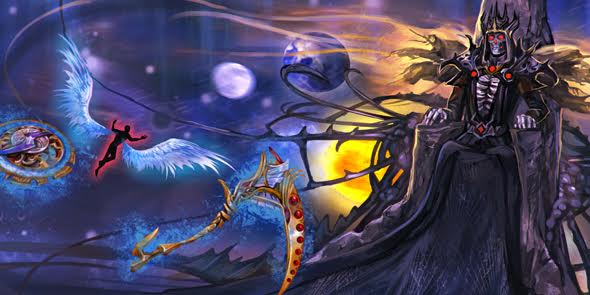
Another light has appeared now...a brilliant azure light! As if in response to the man’s cry, some sort of vision wreathed in blue light has appeared, suspended in mid-air before the man. It is man-shaped and clad in armor of blue gemstone and gold. It bears a golden sword and flies on wings of sapphire. It must certainly come from one of the celestial planes...

The blue light and the red fire mingle...the man and the celestial speak mind-to-mind...this other-memory tells me that the apparition does not offer salvation, but issues a command. The man is to retrieve something, but I do not know what…

The celestial being raises its sword...a single feather carved of azure gemstone appears before the man in the red light, and descends into his waiting palm.

The vision fades from view, and we are alone.

The man stands, contemplating the feather...he turns now and begins to walk. I follow.

A few hours pass before my eyes in seconds...I can see the landscape changing as we go. The dolorthorn is becoming sparser as we move away from the heat source. How strange...perhaps they feed off the energy passing through them somehow?

More time passes...the man has walked for days without stopping for food, water, or sleep...hold...he stops. He kneels and picks an object up off the ground. It is small, round, and wood-like...a seed of some kind? Here, of all places?

From time to time, I see more of these strange creased pebbles on the red ground. The further the man walks, the more there are.

Days pass in the blinking of an eye...I can see hills in the distance! We head towards them...can it be? There is a network of caves in the hills, and...yes...there are man-like creatures walking in and out of them. My other-memory identifies them as the demons native to Uzhkadh, the Shazo.

As we get closer, I can see them more clearly...squat and pale reddish with spindly arms and legs. They move weakly and forlornly as if bereft of energy and will. Surely these cannot be the devils of war from the legends!

At last we arrive at the caves, but the Shazo hardly acknowledge his arrival. One of them stops in his tracks and falls to the ground...his body shrinks and desiccates before my eyes. The strange seeds littering the ground on the way here...they are the remains of the Shazo, drained of their life energy by the unseen force feeding off of this plane.

The Shazo have stopped... one of their hunters has returned to the caves with a brace of dead acrida hares. The others shuffle piteously towards him and begin tearing the flesh from the animals and shoving the raw skin and sinew into their fanged maws.

The man watches them as they feed...I cannot tell if there is any pity in him for these wretched creatures mixed in with the ever-present anger radiating from his being, but he approaches one of them and speaks to him in their unpleasant, guttural tongue. I cannot speak the language, but the words’ meanings flicker into my mind like shadows from a bonfire.

The demon recounts the cataclysm that befell their world. He says that many years ago, a being called Dudrul appeared in Uzhkadh and immediately began to draw all of the plane’s energy into itself. Where once the souls of the vengeful damned permeated this world, they were now drawn deep into the ground, through the land and into Dudrul.

Life on Uzhkadh depends on these souls that willingly nourish the Shazo in exchange for the promise of vengeance. But the Shazo have been cut off for too long, and soon they will wither away completely.

The man stands and raises his hand into the air. A ray of red light shines from it like a beacon, and the Shazo begin gathering in response to the crimson summons.

Many demons have now gathered...the man begins to speak to the assembly in their tongue. He bids them to gather the Shazo dead and bring them to him, and he will feed them all.

Time passes quickly again...the Shazo lay armloads of seeds...dead Shazo...at the man’s feet. Now the Shazo are gathered in a large field, clutching axes as tightly as their feeble hands can hold them. They watch the man as he chops and hacks the ground into long furrows...now I see them sowing the seeds of the dead like grains of wheat.

Weeks pass. Before my eyes, the ridges of red dirt burst with plant life. Shoots sprout and immediately become stalks. The barren field has become become a field of strange multicolored wheat on stiff metallic stalks.

The sown seeds of the dead Shazo have drawn the souls from the earth, away from the pull of Dudrul and into themselves, growing into a kind of soul-infused wheat!

Now, the wheat is being gathered by the Shazo, who no longer shuffle about hopelessly but move with purpose. Time continues to pass quickly...the man shows them how to grind the soul-fed wheat into flour...the Shazo then take turns slitting their own palms and bleeding into the mixture, while it is stirred with spears into dough.

The gory dough is rolled into round loaves and taken down into the caves to be baked in their depths.

The Shazo are now gathered around a great mound of these loaves, and begin to feed...as they eat the bread, their skin begins to darken, changing from pink to red to a deeper blood-red. Whooping with joy, they devour the gruesome loaves by the thousands.

The feast is over now, and the Shazo have completely transformed. Each demon is now three times its original size. Their limbs, once thin and feeble, now ripple with frightful sinew. They have begun stomping their feet and shouting war-chants in their guttural language...the spirit of battle has been rekindled within them.

The man watched the meal and the celebrations without moving, but now he raises an arm into the air. The Shazo, war-loving chaotic demons though they are, cease their revelry immediately and turn their attention to the man. There is a powerful sense of anticipation in the air, as their new leader begins to speak...

The man bids them to don their armor and gather their weapons, for they are to march on Dudrul!

Time passes...the Shazo army is now mustered and numbers in the thousands. They begin marching, led by the man in the aura of red, towards the source of the heat and the absorption of energy...the Shazo are laughing and jeering...licking their chops in anticipation of the coming battle.

Days of marching pass in a blink. The army never stops marching, for the spirits of the vengeful dead now fill them, exhorting them, granting them power in exchange for the promise of violence and revenge. This is the covenant forged by the baking of the soul-bread.

The further we go, the more of the dolorthorn there is. The vanguard are hacking at the metal vines, but their progress has slowed considerably…

Ah!! On the horizon!! I can see some sort of growth on the land, radiating heat and malice, drawing all life and energy into itself…

The man has spotted it too...his aura of pain flares in intensity, and he rises into the air! He flies now, towards the distant malignancy, leaving the Shazo behind to slash their way through the deadly gorse. I follow…

We near the object...I can see now that it is some kind of hideous chrysalis, as tall as a mountain, standing upright in the ground like an obelisk, deep red in hue, pulsating with an evil force...at its base, black tendrils pierce the ground, pulsing greedily as they drink of the souls with which this world was once saturated.

The man’s red glow is extremely bright now. He flies at the chrysalis, examining it, searching for some kind of opening. He tries pulling at one of the armor-like ridges on its midsection, but it does not give way. He punches at it, but despite all his strength, he cannot make a dent.

Pulling back, he considers the chrysalis for a moment...ah! The feather of blue crystal dropped by the celestial! He brandishes it now like a curved dagger, his red aura turning blue around it...as he raises it…

AAH!! The feather-dagger...he brought it down on the chrysalis! It pierced the shell, which cracked...cracks shot through the entire structure...which then burst with earthshattering force! Shell fragments and black ichor flew in every direction...I thought my heart would stop from the noise of the explosion!

There! On the ground! A creature like a monstrous locust, but with the torso and face of a demon! In its taloned hands is a giant golden scythe! This is Dudrul, who has claimed this plane as his own, and all the souls herein! It turns its hideous countenance towards the man, who plunges downwards.

Dudrul slices at the air with the scythe, but the man is too small and quick, and circles the demon-god’s head like a gadfly.

As they battle, I can sense a change coming over this plane...the intense heat and unsettling hum generated by the chrysalis is gone, and the souls of the dead that were once being drawn into the ground to be absorbed into the giant chrysalis begin once again to fill the atmosphere…

The man begins to grow now...the souls have acknowledged him! He has become a god of revenge, and is grown giant now with their power.

He is now of a size with Dudrul...he plunges his fist, still glowing blue with the power of the celestial feather, into Dudrul’s maw!

The head of the demonic locust explodes in a blue light!

The new god of vengeance, ignoring the violent death throes of the defeated demon-god, takes up the scythe of gold...I can hear the Shazo, having now cleared the gorse, stampeding towards us.

They descend on the body of Dudrul and begin devouring it. The grim feast goes on until there is nothing left. The Shazo too now begin to grow in size and power, having fed off the flesh of a god.

There is a blue light...a shining door appears in the sky! One of the celestial beings descends through it...a true one this time, not merely a vision, able at last to enter the dimension now that Dudrul was dead.

It speaks to the minds of those assembled. I cannot hear its voice, but I can sense its imperiousness and contempt...it is demanding something of the red one…

I understand now. It demands the golden scythe.

A hush has fallen over the world. The Shazo are grinning.

In one fluid motion, the god of vengeance sweeps the golden scythe into the side of the blue portal through which the celestial descended, decapitating the celestial in the process.

The god roars...with the strength of stars, he drives the scythe through the side of the portal, tearing a great gash in the sky!

The god of vengeance shouts triumphantly...he rises into the sky and flies through the torn sky into the world of the celestials...he is gone.

The celestial’s head and body tumble through the air. The Shazo, brimming over now with power, rise like a red column and devour it. No part of it remains. The Shazo army now follow their new lord into the portal...and are gone as well.

**********

An urgent knock at the door cracked through the snowy evening silence. “Enter!” said the abbess sharply. An initiate burst in.

“Hierophantess, she has completed the ritual!” she exclaimed breathlessly. The abbess, hearing the tone of the initiate’s exclamation, glanced at the Mage. Wordlessly, they left the room and and made haste to the Chamber of the Ordeal.

The Chamber was on one of the highest levels of the abbey, and so it was several minutes and numerous flights of stairs before the Mage and the abbess arrived at the short hallway outside the sturdy wooden door leading to the room.

Two sisters of the order stood at guard outside the door to prevent interruption of the ritual, as was customary, but they stepped aside as the abbess and the Mage approached.

Inside was an antechamber and the door leading to the Chamber proper. The abbess rushed through the door, while the Mage stayed behind in the antechamber. The uninitiated were not permitted to enter.

The Chamber of the Ordeal was a large, pillared stone room whose distant far wall had been removed, and normally opened onto a grand mountaintop vista, though all that was visible now was night and snow.

The air was heavy with scented oils and herbs of purification. A stone bench sat in the middle of the Chamber, on top of which lay the acolyte, surrounded by sisters of the order. One of them held aloft a blue-green crystal which glowed with a healing light.

The acolyte was breathing heavily and her eyes were open, but she did not respond to the sisters’ attempts to awaken her from her spiritual journey.

The abbess rushed into the circle of women. “How did she fare?” she asked the sister holding aloft the crystal.

“Her vision was extraordinarily detailed.” replied the sister. “She recounted all from His arrival to His march on Zelantangelus. However, it was an enormous strain on her body and mind.”

The abbess clutched the sickle symbol around her neck. “O Harvester,” she whispered, “please return her to us.”

“Awaken, child!” she then urged the acolyte. “Your kingdom needs you.” But the acolyte did not acknowledge her plea.

The sisters continued their ministrations. The abbess stepped back. The ritual had to be completed.

Addressing the assembly, she said:

“Sisters! Has she been granted a vision clear and true?”

“Yes, Hierophantess!” replied the sisters in unison.

“Has she seen the truth of the Red Realm?” asked the abbess, more loudly.

“Yes, Hierophantess!” replied the sisters.

“And has she…” here, the abbess’ voice faltered slightly, and she hesitated for a moment, before continuing, “...has she returned to carry out her duty and lead us with her Sight?”

But the room was silent, save for the distant sound of the wind among the mountain peaks.

And then, very quietly, a weak voice was heard:

“Yes...Hierophantess…” whispered the new initiate, an acolyte no longer.

Outside the room, the Mage smiled to himself as he heard a joyous cheer erupt from the Chamber of the Ordeal.



The murmur of life in the streets and alleyways of Magna Messor always carried an undercurrent of reverence, for the city was home to the holy seat of the Order.

The bright morning sun shone down upon the Archpantheon at Magna Messor. Its rays entered the great temple through an array of stained glass windows and warmed the cool autumn air inside its vast chapel, where the Order’s annual ceremony of investiture was underway.

Every seat of every pew was full. Soldiers, clergy, aristocracy, and specially invited members of the public had come to bear witness to the ceremony in devout silence.

At the front of the large chamber, six initiates who were to undergo full ordination into the Order sat on chairs in a semicircle behind a tall pulpit.

Conducting the service from behind the pulpit was High Redemptor Tynus, a wizened and white-bearded cleric whose soft, quavering voice battled against the wakefulness of those assembled:

“...for as St. Pillo said to the Kimorites: ‘All those who war shall pay a tithe unto Him, but the victorious alone shall reap,’ for in battle is found victory, and in victory are we brought nearer to Him...”

In an enclosed section reserved for royalty, important dignitaries and senior members of the army, The Mage stifled a yawn and turned his mind back to matters of war, while High Redemptor Tynus wheezed on.

It wasn’t until three quarters of an hour later that the Mage at last heard the High Redemptor say something that brought him back from his machinations:

“...who will now read to us from the Book of the Cosmos.”

With that, High Redemptor Tynus slowly turned and began shakily descending the steps of the pulpit. One of the initiates jumped out of her seat to offer him her arm, which he took with bad grace.

Once the initiate and the High Redemptor were both finally seated, a door at the right-hand side of the chancel opened. A woman in white and emerald silken vestments entered the chapel, carrying a small book.

The Mage smiled a rare smile as she ceremoniously ascended the stairs to the pulpit and placed the book on it. Opening the book, she looked up confidently at the assembled faithful.

“Good morning,” said the former acolyte to the congregation, “I will now read to you from the writings of St. Gustaive in the Book of the Cosmos...”


The Locust-King lay buried in the bellies of the Shazo.
In his wake, a golden scythe of sublime beauty,
Crafted by celestials and powerful beyond all other arms.
The Holy Farmer claimed it as His prize.

The Harrower slit the throat of the crimson Uzhkadh sky,
Throwing open the door between worlds.
Through this shining scar the Holy Farmer and the Shazo flew
Into shining Zelantangelus.

A world with no land, only golden sky and white clouds
Lit by an unseen sun, never knowing night.
Where dwelt an angelic race on wings of blue crystal.
The archenemies of sin, the saintly Zelantine.

As one the Zelantine flew in perfect serried ranks
Extending as far as sight could see.
In perfect unison, the drew their swords of shining gold.
In dreadful harmony, they sang of their grim purpose:

To scour the cosmos in the fires of righteousness,
To cleanse all worlds of life, and thereby of sin.
To crown their king, almighty Zelantangelus
Whose world bears his name, as ruler of all creation.

In their myriad ranks they flew, golden blades held aloft,
An endless field of wheat, terrible and splendid.
They commanded the Holy Farmer to relinquish the golden scythe
And submit to the judgment of Zelantangelus the most pure.

Yet Shazo showed no fear, and mocked and jeered at the Zelantine,
And the Harrower raised His hand, and sounded the attack.
Unseen trumpets blared and the Zelantine charged,
And savage war began.

The blue flock met the red swarm, and the dead rained down.
Red claw bit blue wing, yellow tooth drew golden blood.
Golden blades pierced black armor.
Down fell the dead, into the hungry rift below.

The Shazo were outnumbered, yet they had the upper hand,
For so fearful were the Zelantine of corruption
That any who made contact with the enemy
Were slaughtered by their own comrades for their impurity.

The Holy Farmer fought His way through the Zelantine ranks,
The dead in his wake numberless.
His golden scythe flashed and swirled ceaselessly
As higher and higher he rose.

Left behind were the shouts of the Zelantine and the jeers of the Shazo
As the Farmer rose higher through layers of ivory cloud
Until at last, he reached the dwelling of the king,
Almighty Zelantangelus with his golden astrolabe.

The great angel spoke to the Harrower:
“At last you have come. Long have you suffered and far have you journeyed.
You have done well to bring the golden scythe to me,
but I do not have the soul you seek.

I once served the great god, Death, alongside Dudrul, who you destroyed.
Together, we forged the golden scythe and astrolabe.
They were to give Death power over the cosmos
And allow him to rewrite the laws of nature.

He would have twisted the universe, changed it into
A constantly churning machine of war
To create an unending stream of lives to be sacrificed to him
To feed him until the end of time.

That’s why Dudrul and I conspired to steal these golden artifacts,
Flee to other worlds, from thence to steal souls,
Until the day we were strong enough to challenge the other
And from there, armed with both golden items, to destroy Death and ascend to his throne.

And now, with the power of the scythe and the astrolabe, I shall purify the cosmos
And all worlds shall be as this one, untainted by the touch of man or demonkind.
You have my thanks for bringing the golden scythe to me,
But I do not have the soul you seek.”

But the Holy Farmer fell upon the treacherous god,
They fought, golden scythe against azure spear.
For days upon days, they clashed above,
While the armies of the Shazo and the Zelantine clashed below.

But although Zelantangelus had the golden astrolabe,
It did not respond to his beck, though it was equal to the scythe
For it recognized the Harrower as its true owner,
By right of conquest and by dictat of fate.

The astrolabe betrayed Zelantangelus as he once did its first owner
And the golden scythe pierced his outer flame.
The Harrower tore the wings from the Angel-King’s back and placed them on Himself,
And Zelantangelus was cast down into the rift.

With the golden scythe and golden astrolabe reunited,
A door into a plane of night appeared before the Holy Farmer.
He left behind the battle and entered the door
To Death’s starry prison.

The Grim King greeted the Harrower from his dark throne:
“You have served me well, O son of mortals.
You have brought down my judgment on those who betrayed me
And with my aid shattered the bonds of mortality.

And because you have restored to me my holy trappings
Your reward shall be great indeed.”
And in Death’s hand was a small metal box
Wrought of black metal and bound in chains of black.

“I award to you the soul of the one who wronged you
And brought upon you great suffering.
The one responsible for your life of death and pain,
All in the name of an empty prophecy.

To you I grant this black soul to do with what you wish,
To repay eternally the evil done to you.
And what is more, you shall sit by my side as a god of revenge.
This you have earned, for you have served me faithfully.

What say you, O son of mortals?” asked Death
As the black box passed through the air into the Holy Farmer’s hands.
But the Holy Farmer spurned the gift, and cast it away from Him
And said: “NAY! I AM COME FOR THEE,

THOU THIEF, WHO HAST OF ALL THAT I HELD DEAR ROBBED ME,
WHO HAST USED ME AND CAST ME ASIDE,
WHO HAST TWISTED MY SOUL AND THROWN ME INTO THE PIT
TO FIGHT THY ENEMIES IN THY STEAD.

FOR TWAS THY PROPHECY IN THE KING’S EAR.
TWAS THY BETRAYAL LED MY PEOPLE TO RUIN.
TWAS BY THY FOUL ART I WAS FORBIDDEN TO DIE.
AND NOW IT IS THY SOUL I STAND IN CLAIM OF, IF THOU HAST ONE.”


And Death was dismayed, for he saw that the scythe and the astrolabe
Had chosen the Holy Farmer as their owner.
And he understood that his time had drawn to a close
His creation having surpassed him.

“Very well,” said Death. “Would that I had my scythe and my astrolabe still
For without the power of foresight they granted I have paid dearly.
I am fated to be your first victim as the new god of Death, but know this:
By taking my life you are bound to my throne.

My power is yours, and the scythe and astrolabe as well.
You will have control over all cycles in the cosmos.
Life and death, the days, the seasons. War, peace, and fate.
Men and wheat shall rise and fall under your governance.”

Without a word or a groan, the old god faded from existence.
In his place sits even now the Holy Farmer.
God of the cosmos and all the cycles. The Sower and the Reaper.
May He reign forever.

*********

“May He reign forever,” murmured the congregation in response, as the acolyte closed the book and descended the steps. She took a seat among the other initiates as High Redemptor Tynus resumed his spot at the pulpit.

“Thank you, sister,” he wheezed. “I am reminded of the trial of St. Lemka, who fought in the Garne War against the heathens at Bellephus, when she was sent out into the desert without food or water, and was then visited by the spirit of…”

The Mage thought back to the poised and dignified cleric who read the words of St. Gustaive in so clear and strong a voice. Gone, it seemed, was the quiet young acolyte he set out with all those years before. What had begun as wide-eyed awe and quiet reverence had grown into steady faith and confident resolve.

The Mage looked at the former acolyte in her holy vestments. The role she was about to undertake was of great importance to her kingdom, and the look in her eyes told him she understood what would be required of her, and was ready to shoulder the burden.

There it is, he thought. Heart of a shieldmaiden.

Suddenly, she looked out at the congregation and saw the Mage. She smiled brightly at him before turning back towards the pulpit, and there was that young acolyte once again.

An hour later, the High Redemptor had ordained the six initiates, and was at last completing the ceremony of investiture on the acolyte.

“Sister Frekka Krondottir, do you reject the trappings of your former life and identity to devote yourself to a life of servitude to the Holy Farmer and to your king?” he quavered.

“I do,” she replied.

“Then by your devotion and your faith you do your god and your lord proud. Long may you serve the king, in peacetime and in war, and by your good counsel may our country prosper and may the Holy Harrower smile upon us.

“I welcome you, Oracle. May your vision be clear and may you see far. Go forth and serve your god and king!”

And with that the congregation broke into applause, and the bells of the Archpantheon at Magna Messor rang out into the autumn afternoon.
 
Status
Not open for further replies.
Back
Top